Characterizing natural sound representations with magnetoencephalography
Everyday listening takes place in a rich acoustic world full of meaningful events (footsteps, tools, animals, machines etc.). Natural sounds are therefore a useful instrument for characterising how the brain links acoustic structure to the objects and actions that produce them. In earlier behavioural and 7T fMRI work, we showed that natural-sound organisation in perception and auditory cortex is captured particularly well by intermediate layers of sound-processing neural networks. This points to representations that are neither purely acoustic nor simply verbal labels, but sit between sound structure and meaning.
In this talk, I will focus on a new MEG dataset designed to follow this transformation in time. The main result is a clear progression from early acoustic representations (~100 ms) to sound-learned categorical representations (~250 ms), to sound-learned continuous semantics (> ~500 ms). MEG therefore makes it possible to describe how natural sounds move from acoustic detail to event meaning within the first second of listening.
I will then present two extensions of this result. First, information-decomposition analyses show that different MEG latencies model provide both shared and complementary information about computational model representations. This suggests that the brain does not simply pass from acoustics to meaning in a single sequence, but keeps integrating sound-driven representations over time. Second, causal CRNN modelling confirms that temporal integration matters: causal models that combine multiple temporal scales within a single recurrent architecture explain MEG responses better than isolated temporal scales treated separately.
The final part of the talk asks whether there is really one acoustic-to-semantic cascade for all sounds. Most analyses implicitly treat every sound as following the same route through the brain, but recognition should change that route. Sounds that are easy to identify can be rapidly linked to labels and sources, whereas ambiguous sounds should keep processing closer to the acoustic signal. This is what we find: well-identified sounds show faster access to sound-label similarity, while poorly identified sounds show more sustained sound-based representations.
Together, these MEG results characterise the dynamics by which everyday sounds become meaningful auditory objects and events, and provide a basis for moving from isolated sounds to the richer case of real-life auditory scenes.
Biography
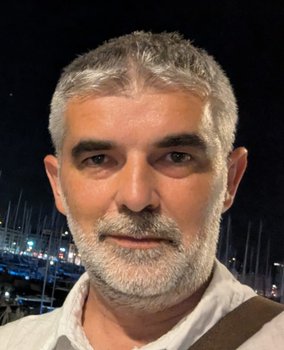
Dr. Bruno L. Giordano is a CNRS permanent researcher (CRCN) at the Institute of Neurosciences de la Timone (INT; Aix-Marseille Université & CNRS). He completed his PhD in Perception and Psychophysics at the University of Padova, Italy, and IRCAM-CNRS, Paris, in 2005. Before joining CNRS in 2017, he held positions at McGill University, and the University of Glasgow. His research focuses on understanding the neural and behavioral processes underlying the perception of natural sounds, integrating psychoacoustics, auditory neuroscience, and computational modeling. Dr. Giordano’s work has been published in journals such as Nature Neuroscience, Neuron, and Nature Human Behavior. His recent collaboration with Prof. Elia Formisano (Maastricht University) laid the foundation for the ERC Synergy NASCE project, which investigates the computational underpinnings of natural sound representation in everyday sound scenes.